
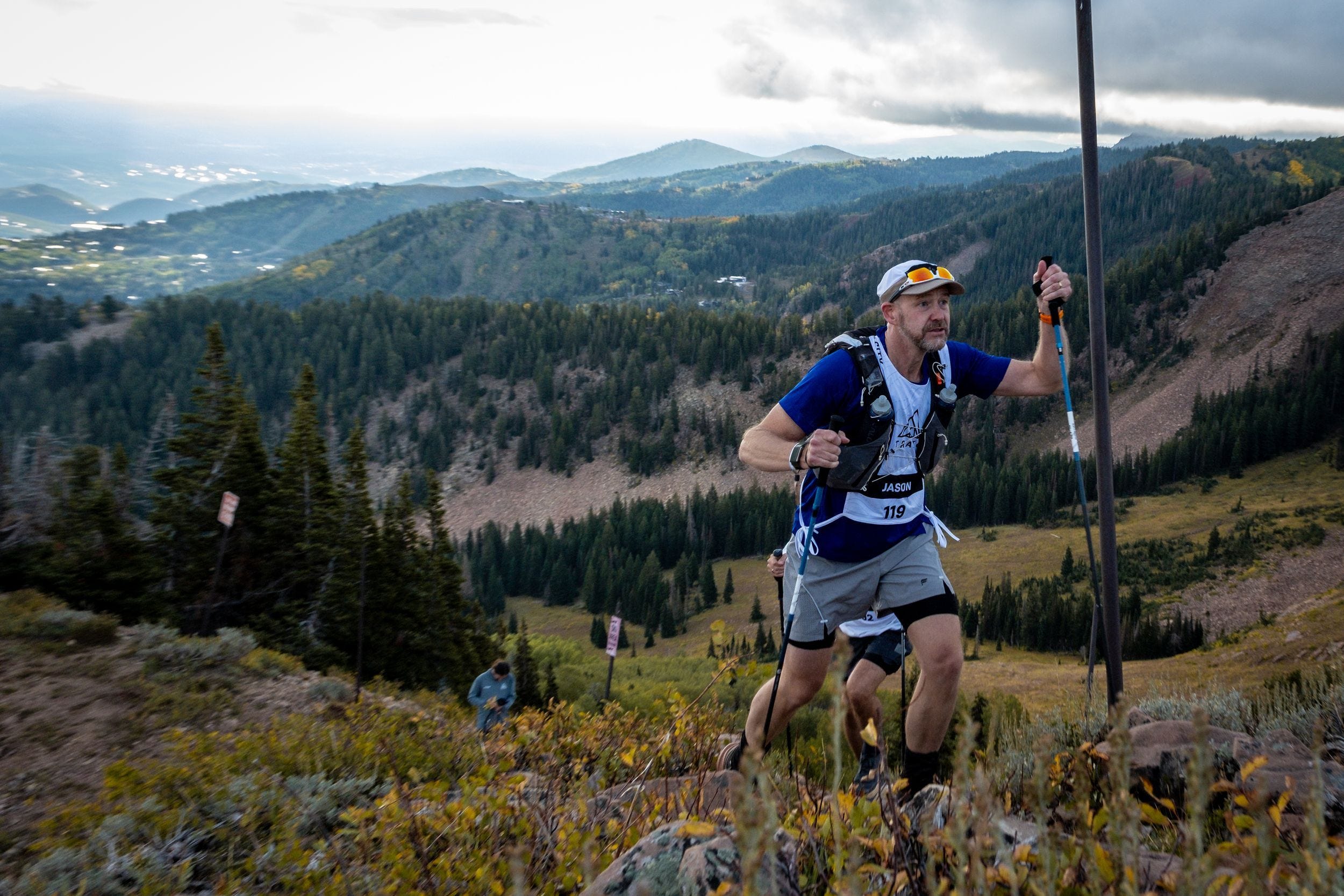
Seventeen miles into the third day of 29029 Trail, three trail marathons on three consecutive days in the mountains of Utah, Coach Chris Hauth looked at me from under his cowboy hat and asked, “Are you feeling it yet?”
“Feeling what?” I asked.
“Feeling like your mind and your body are telling you to stop, but you’re not going to.”
“I’ve been feeling that for the last ten miles, Coach. But I’m here now, so I’ll just keep grinding.”
His smile broadened. We bumped fists as I climbed past him, and he called after me, “That’s why we do this!”
By all rational measures, this was not the best summer for an ultra. We were splitting time between Boston and Maine while moving into the generational farmhouse we bought from my parents so they could downsize into a more manageable home. We helped my parents through their house move and a hospitalization. We moved our oldest out of her college apartment into her apartment for her first job. We helped our youngest manage her internship and her move back to college. Work was moving at full speed as we build new products. Meanwhile, I was putting in hundreds of hours of training, six to seven days per week, with Saturdays and Sundays often including five-to-eight hour sessions. Yet this was exactly the right summer to train. With so many challenges and so many unknowns, hard training was a way to build confidence in myself. If I could take on this work, I could meet the other challenges ahead.
Since our kids were young, we have often used the phrase “I do hard things” as a self-confidence reminder that we are more capable than we give ourselves credit for. Life is full of uncertainties and new challenges, and the most powerful skill any of us have is the ability to “do hard things”: to see a goal, identify the work required to achieve it, and forge ahead. We may fail to reach many of our goals, but we will have been worthy of them and willing to do the work. For me, the way I build confidence is by doing the hard things.
Self-elected hard work prepares us for the hardships we do not choose. Michael Easter focuses on this idea in his book The Comfort Crisis, challenging people to take on a yearly misogi: a bold challenge with roughly a fifty percent chance of success. In The 12 Hour Walk, inspired by his solo trek across Antarctica, Colin O’Brady reminds us of this simple reality: discomfort is the toll paid to reach our goals. If discomfort is required to reach our goals and is guaranteed to occur in our lives, how do we prepare ourselves? By choosing to take on hard challenges. Doing so helps us overcome the fear of things being too hard, it desensitizes us to the shock of surprisingly hard challenges, and it builds in us a confidence that limits, like fears, are often illusions.
AI is one of the greatest triggers of uncertainty and doubt in so many people today. At its core, many people fear what comes next. They lack confidence that their skills will be needed in the future. They also feel that keeping up with the latest advances and harnessing the technology is perhaps beyond them. In short, many people do not feel ready for the next phase. In reality, we are never truly ready for the next phase of our lives, whether that’s relationships, children, work, or new technologies. The objective is to be ready for the next challenge, whatever form it arrives in. When new challenges stop holding you back, a world of opportunity arises.
Feelings lie. “I don’t feel ready.” “I don’t feel motivated.” “I don’t feel I’m the right person.” Much of our self-limiting talk is based on our feelings. Our feelings frequently stem from our lizard brain trying to protect us from a perceived danger. While important to recognize, our feelings are terrible guides for the actions we should take. How many times have you not “felt like” going for a workout but then after you push through the feeling and take the action you feel energetic and motivated? Feeling follows action. That is a reality of how our brains work. The objective, therefore, is for us to build a habit of action and to trust that the feelings we want will follow those actions. Building a habit of action fits together with conditioning yourself to do hard things. We do hard things to produce the inspiration, gratitude, and accomplishment we were waiting to feel.
Ask yourself the question Coach Hauth asked me: are you feeling it yet? Do you have opportunities in your life that you’re working hard to achieve despite not being certain you are capable? Or are you letting your feelings decide, and standing still? If you are in the latter group, I encourage you to pick something hard, something you are not sure you can do, and simply go do it. It does not have to be an ultramarathon. It does not need to be an athletic achievement at all. It could be a new skill, such as learning the piano, or having a hard conversation you know needs to happen. Whatever is hard for you is the thing you need to go do. Life will continually put hard challenges in our path. The most important skill we can develop is the ability to take those challenges on with the confidence that we can, in fact, do hard things.
AI Provenance: My ideation began as a written brain dump of ideas. My editorial agent (running Opus 5.5) helped synthesize those into an outline. I wrote the full prose draft. Editorial passes caught grammar mistakes and helped correct tense and point-of-view inconsistencies. I manually changed some of my writing based on editorial suggestions; I ignored others. In a few areas I took suggested sentence rewrites from my agent to correct structural inconsistencies. I owned the final read and edits to ensure this represents what is in my head and my heart.